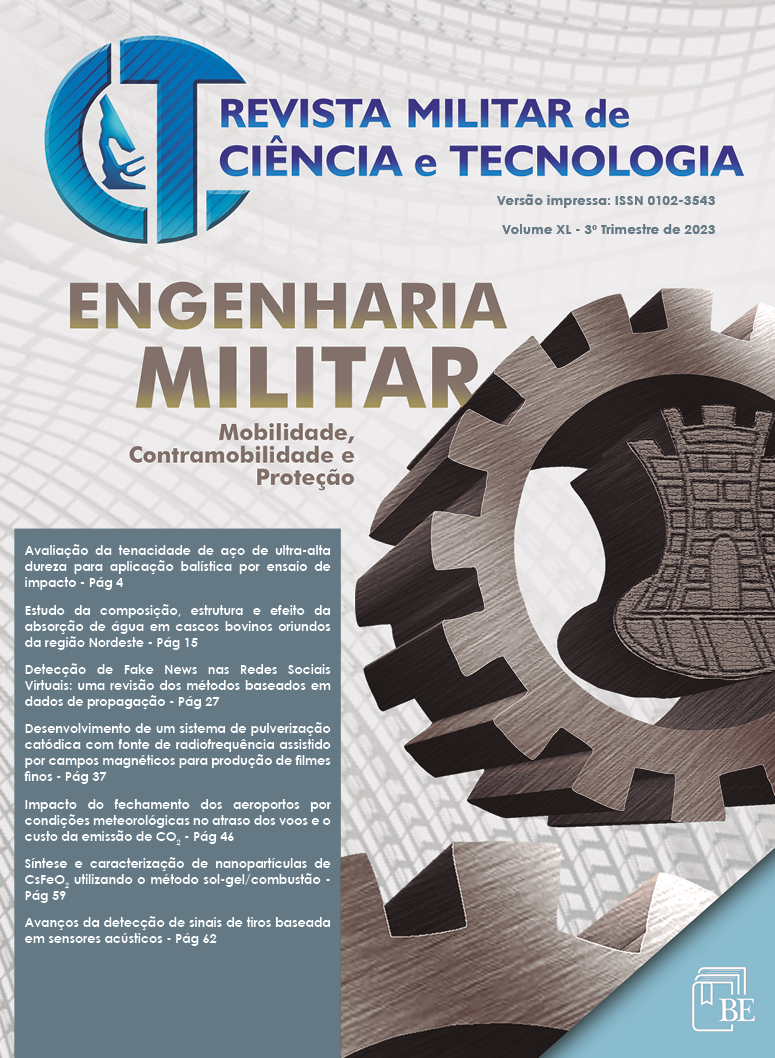
Impact testing to evaluate the toughness of ultra-high hardness steel for ballistic applications
DOI:
https://doi.org/10.22491/rmct.v40i3.11270.ptKeywords:
toughness, ductile-brittle transition temperature, impact testing, ultrahigh hardness steelAbstract
Ultra-high hardness armor grade steels are commonly used in sectors such as patrol vehicles, cash-in-transit vehicles, armored personnel carriers, building protection, among others. The aim of this work was to evaluate the toughness of a material in this class by determining the ductile-to-brittle transition temperature (DBTT) using some of its definitions. Charpy impact tests were conducted and the fracture faces of the specimens were evaluated through both macroscopic and microscopic analysis. The tests were conducted at temperatures ranging from -60°C to room temperature, using specimens extracted longitudinally to the rolling direction. Micrographic analyses indicated that determining the DBTT using the energy absorption criterion is appropriate and reliable. The obtained results show that, based on an absorbed energy of 12.92 J, the transition temperature is -27.73°C.
Downloads
Downloads
Published
How to Cite
Issue
Section
License
Copyright (c) 2026 Charles Hudson Martins de Vasconcelos, Cristhian Ricardo Loayza Loayza, Ademir Ângelo Castro Filho, Eduardo de Magalhães Braga, Andersan dos Santos Paula, Ricardo Pondé Weber

This work is licensed under a Creative Commons Attribution-NonCommercial 4.0 International License.
A Revista Militar de Ciência e Tecnologia está licenciada:
A partir de 2022 sob as condições do Creative Commons (CC BY 4.0)
Até 2021 sob as condições do Creative Commons (CC BY-NC-SA 4.0)
Copyright: Os autores são os detentores do Copyright, sem restrições, de seus artigos.
As licenças estão informadas na página de acesso do artigo e são detalhadas a seguir:
Sob a licença CC-BY 4.0, você tem o direito de:
Compartilhar — copiar e redistribuir o material em qualquer suporte ou formato
Adaptar — remixar, transformar, e criar a partir do material para qualquer fim, mesmo que comercial.
De acordo com os termos seguintes:
Atribuição — Você deve dar o crédito apropriado, prover um link para a licença e indicar se mudanças foram feitas. Você deve fazê-lo em qualquer circunstância razoável, mas de nenhuma maneira que sugira que o licenciante apoia você ou o seu uso.
Sob a licença CC-BY-NC 4.0, você tem o direito de:
Compartilhar — copiar e redistribuir o material em qualquer suporte ou formato
Adaptar — remixar, transformar, e criar a partir do material
De acordo com os termos seguintes:
Atribuição — Você deve dar o crédito apropriado, prover um link para a licença e indicar se mudanças foram feitas. Você deve fazê-lo em qualquer circunstância razoável, mas de nenhuma maneira que sugira que o licenciante apoia você ou o seu uso.
Não Comercial — Você não pode usar o material para fins comerciais.
CompartilhaIgual — Se você remixar, transformar, ou criar a partir do material, tem de distribuir as suas contribuições sob a mesma licença que o original.
Sem restrições adicionais — Você não pode aplicar termos jurídicos ou medidas de caráter tecnológico que restrinjam legalmente outros de fazerem algo que a licença permita.
Aviso
Para qualquer reutilização ou distribuição, você deve deixar claro a terceiros os termos da licença a que se encontra submetida esta obra.